
.jpg)
Sarit Cohen’s ceramics emerge from a life shaped by movement across continents, by family histories that do not sit easily within a single national or cultural frame, and by an education in clay that treated ceramics not as a minor or merely functional medium, but as a material capable of holding form, thought, memory, and the pressures of lived experience all at once. Born into a family whose history moves across India, Nepal, Turkey - Judaism, and later Israel, and formed in Australia after years of life here, Cohen’s work carries within it a layered inheritance of migration, adaptation, domestic ritual, colour, architecture, and memory, not as a set of themes applied after the fact, but as conditions that seem to have settled into her way of seeing long before they ever reached the kiln. That inheritance is even more layered than a brief biographical summary can fully hold. On her father’s side, Cohen’s family history moves through Istanbul, Sephardic Jewish migration, and the Ladino language spoken at home, rather than Turkish, before the family’s wartime movement to Palestine in the early 1940s. On her mother’s side, the family story moves through north India and the Kalimpong region, with close Nepalese connections in earlier generations. These are not details to be laboured for their own sake, but they do sharpen what the work already seems to know: that culture is often carried not as a single origin, but as a gathering of languages, displacements, and inheritances that survive by being recomposed.
English is her second language after Hebrew, and that fact feels quietly significant in relation to the work, because if, as John Berger wrote, “seeing comes before words,” then in Cohen’s case one might say that clay comes very close to being a first language, or at least a language that runs beneath speech, grounded less in verbal explanation than in touch, balance, rhythm, and form.¹ The thought is not fanciful when set against the bodily memory that seems to underlie the work: sand, dirt, water, clay, the earliest knowledge of matter pushed, held, shaped, and rearranged by hand. This matters not simply as poetic analogy, but because it helps explain the precision of her later process, in which looking, touching, weighing, and judging arrive before explanation, and in which form is often known bodily before it is named verbally. The family history of Ladino, Hebrew, migration, and partial linguistic loss across generations only intensifies this sense that Cohen’s deepest fluency lies not in declaration, but in the shaping of relation through matter itself.
Her own account of inheritance is direct, but never programmatic. She speaks of having established herself as Australian, for many years, while still being shaped by a wider cultural history of movement, food, architecture, and ceremony, and that doubleness, or rather that multiplicity, matters because it gives the work its sense of being made from many parts without ever feeling divided against itself. What her ceramics hold is not identity in any thin or declarative sense, but something more layered and harder won: the slow settling of many visual, cultural, and familial inheritances into a coherent formal language.
That sense of formation was sharpened further by her education at the Australian National University School of Art, where she graduated in 1992 into a workshop culture already distinguished by the seriousness with which ceramics was taught and practised. That culture had been substantially shaped from 1977 onwards under the founding directorship of Udo Sellbach, whose Bauhaus-derived philosophy made the practice of art the crucial foundation of the School’s teaching, curriculum, and organisational structure. The workshop model, drawn in part from Sellbach’s own training at the Kölner Werkschulen, brought fine arts and craft disciplines together in studio-based environments led by practising artists, making the teaching context closer to a professional art practice than a conventional academic program. The Ceramics Workshop at ANU, as Michael Agostino’s history of the school makes clear, belonged to one of the major strands in the institution’s life, supported by specialist teaching, strong technical knowledge, and an understanding of clay that moved comfortably between functional pottery, sculptural inquiry, glaze chemistry, and experimental object-making.² Figures such as Hiroe Swen, Alan Watt, Janet DeBoos, and Anita McIntyre formed part of that context, and it is important to recognise that Cohen’s work did not emerge in spite of such a tradition, but through it, even as it has since taken the vessel somewhere distinctly her own.
This biographical and educational context matters because Cohen’s ceramics are not simply elegant objects, nor simply arguments about craft, design, or cultural identity, but something more integrated and elusive than any of those single descriptions allow. They belong to the long history of vessels, among the oldest and most intimate forms human hands have ever made, and yet they remain deeply contemporary because they continue to carry far more than use, holding within their contours the possibility of hospitality, ceremony, offering, relation, and the emotional residue of domestic life. The vessel survives not because it is still necessary in any ordinary practical sense, but because it remains one of the few forms through which intimacy and structure, utility and symbolism, can still meet without strain. Cohen has stayed with that form for decades, though never dutifully and never by way of repetition alone, returning again and again to bowls, cups, platters, vases, and everyday containers in order to test what else they might become once cut, stacked, recomposed, and brought into a different spatial register.
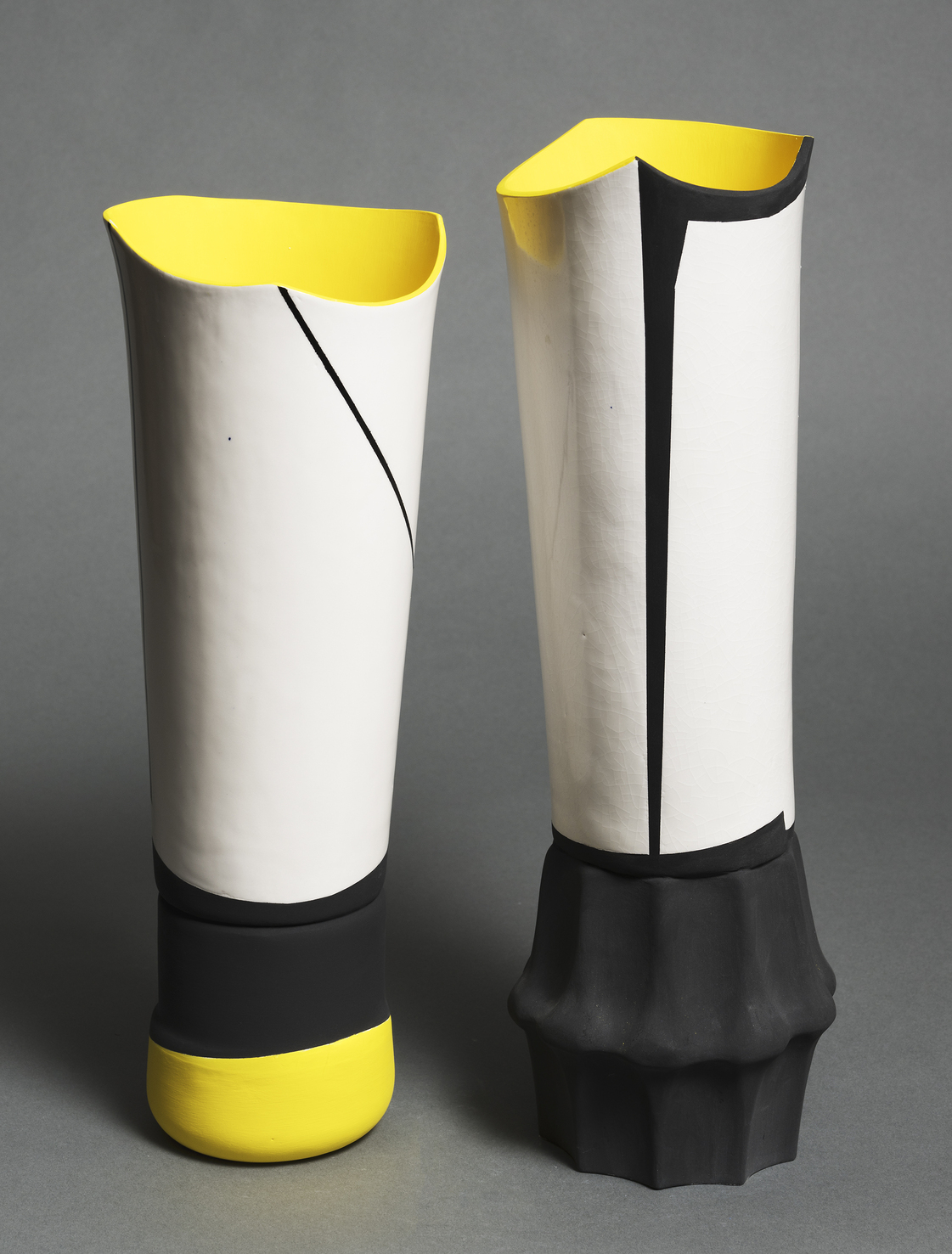
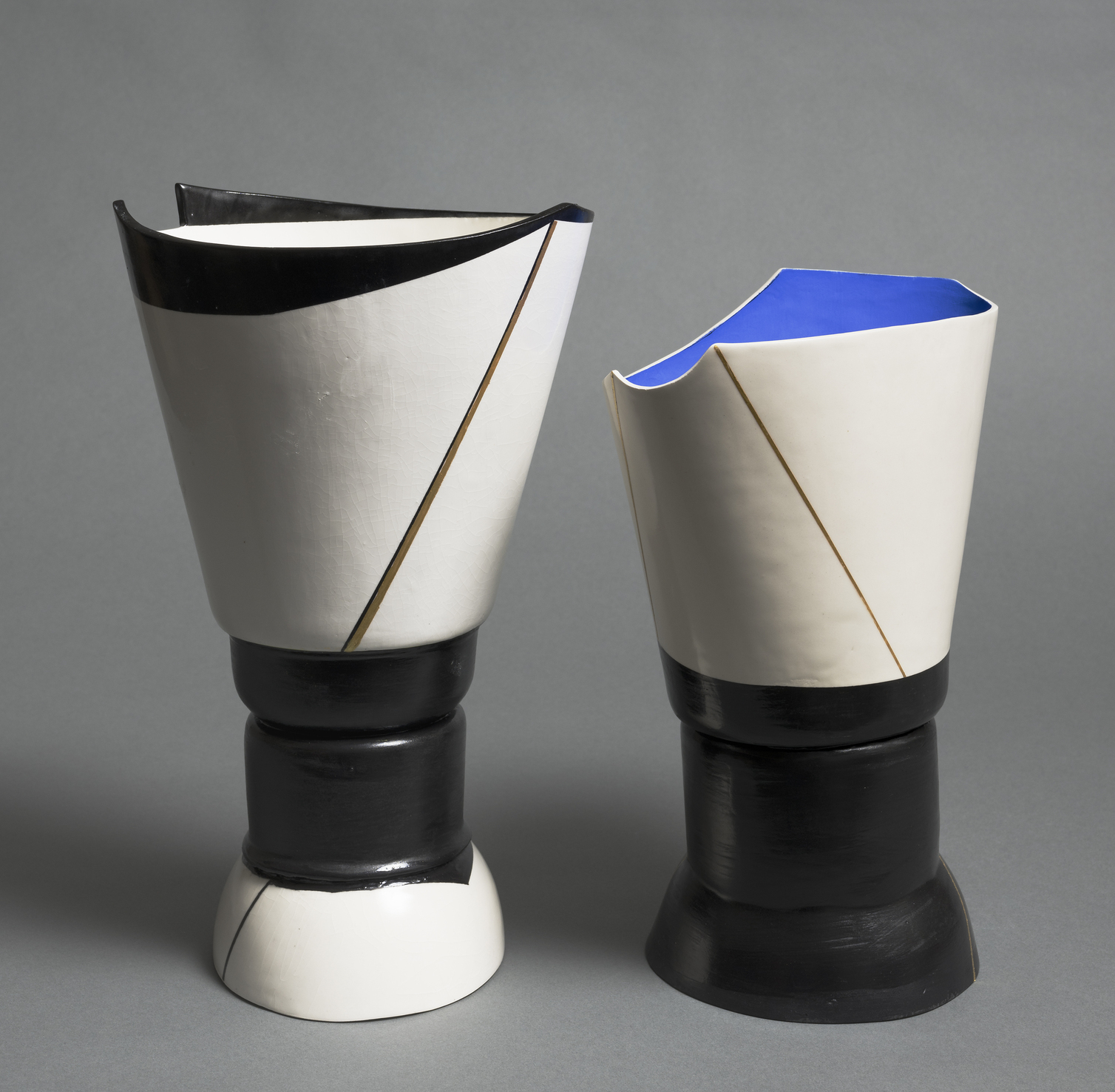
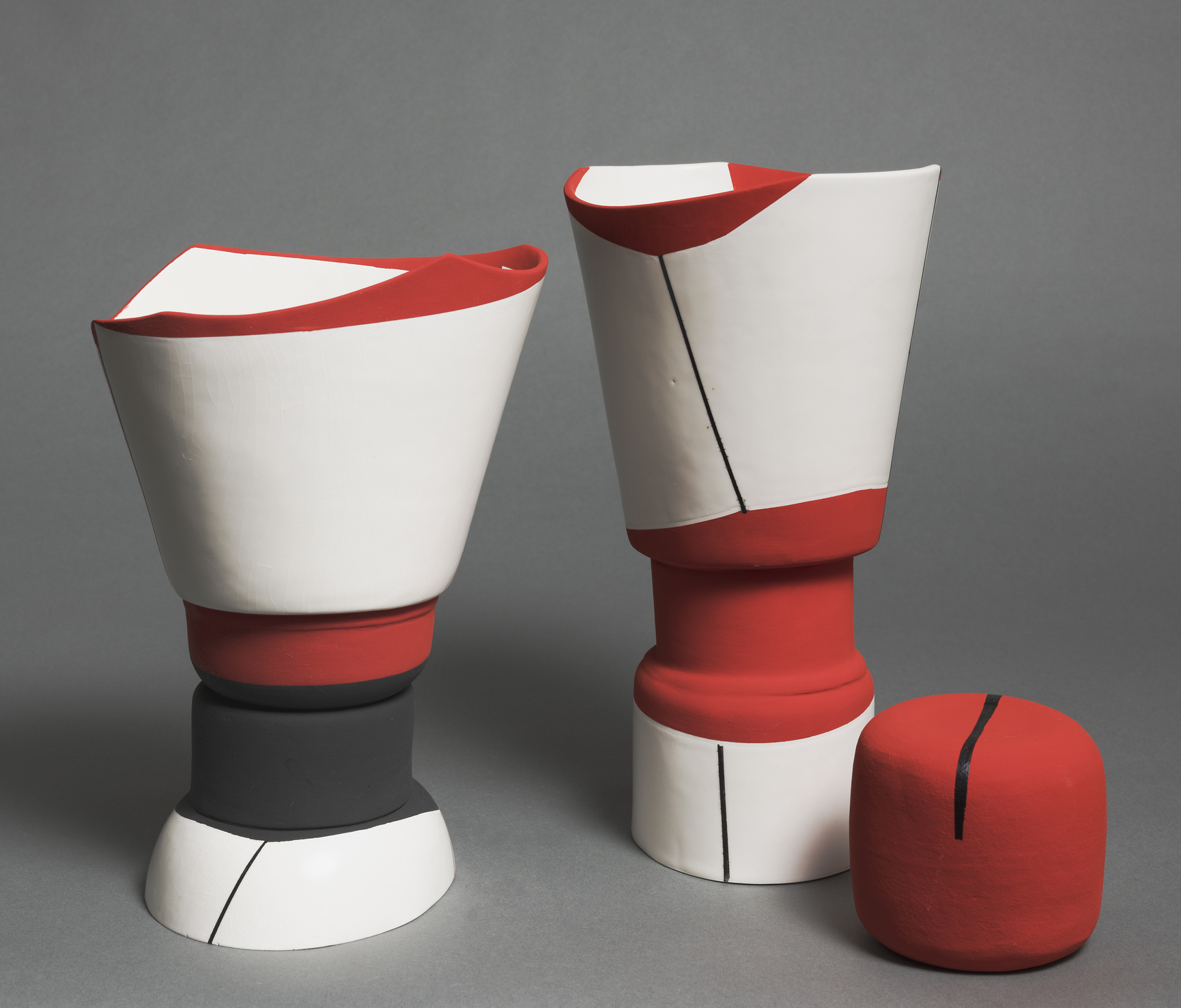
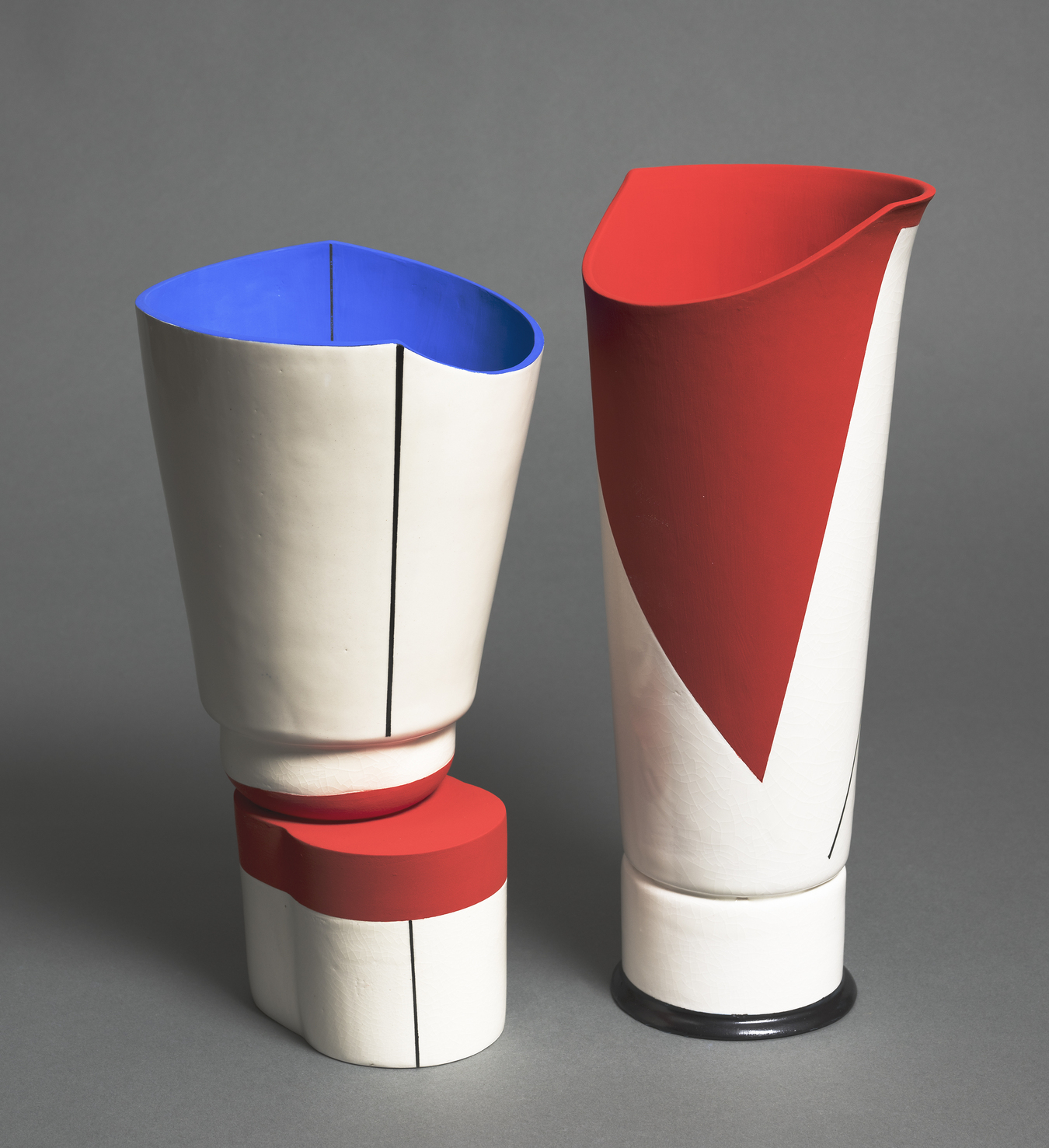
What emerges in her work is a vessel that continues to remember containment while no longer behaving like a simple container. Her forms rise and steady themselves with the quiet assurance of compacted architectural fragments, retaining the memory of cups, jars, and domestic objects while standing with the poise of columns, facades, or small built propositions. Cohen herself has described her practice through “strong lines, geometric abstract patterns and a unique balance of architectural shape and space,” and the force of that description lies in the way it acknowledges both sides of the work at once: its rootedness in the vessel and its movement toward architecture.
Cohen has also flagged Edmund de Waal, Anne Dangar, Lucie Rie, and Elizabeth Fritsch as important points of reference, with Fritsch especially relevant to her interest in optical illusion and perceptual play. That constellation is telling. It places her practice in dialogue not only with the vessel tradition at large, but with artists who have each, in different ways, pushed ceramics toward architecture, rhythm, disciplined surface, and the subtle unsettling of form through pattern, proportion, and line.
Architecture, in this sense, is not merely a reference or a visual quotation, but one of the deeper logics through which the work is made. Cohen has spoken of architecture as always being in her mind, describing the way she looks at buildings from a distance or enters a room and immediately registers the sense of balance within it, the way a structure distributes its weight, the way spatial relations can steady a body before the mind has fully named what it is seeing. Her vessels do something similar. They do not simply resemble buildings. They think architecturally. They hold themselves in space as though governed by an internal discipline of support, uplift, grounding, and interval, and that is one reason they feel so complete even when they remain close to the scale of handling and domestic touch. They are intimate, but they are never slight. They are small structures of thought. In that sense, their architectural quality feels less like stylistic quotation than like an act of cultural holding, as though dispersed histories, broken lines of transmission, and fragments of place were being steadied into form.
That poise begins far earlier than the finished object, and one of the most revealing things about Cohen’s practice is the precision with which she describes the earliest act of selection. She does not begin by imposing an abstract idea upon clay and then finding a way to illustrate it. She begins by looking, and by judging, and by deciding whether a form carries the right internal logic to become part of her language. Slip-casting is crucial to her process, but before the slip is poured comes an act of discernment in which she chooses from ordinary domestic objects, bowls, vases, pieces of crockery, plastic containers, and other everyday forms, not because of their decorative surfaces or their obvious use, but because of their profile, their base, and the way they sit in space. She has described turning such objects upside down in order to decide whether they “work” for her, tuning out text and surface branding and looking instead at how a base lifts a form or pushes it downward, at the relation between belly and neck, rim and height, width and rise. What becomes clear in that description is that proportion is not a secondary concern in this work, but its generative principle, and these ceramics feel balanced because balance is present from the first act of choosing.
This way of working also clarifies the kind of construction that is taking place in the studio. Cohen is not assembling readymade objects in order to preserve the friction of their former lives in the manner of an artist working through found-object sculpture, nor is she simply collaging completed fragments into a loose aggregate. What she builds is closer to a new body, or a new skin, one made from many prior forms but brought into such visual coherence that the finished work feels neither accumulated nor pieced together, but wholly reauthored. The joins and seams do not remain as badges of juxtaposition, but are absorbed into a unified formal language, so that the work reads less as assemblage than as a newly coherent body, one in which many parts have been persuaded to speak as one. She returns repeatedly to a family of everyday objects, keeping certain contours and structural relations constant while altering lip, height, junction, and proportion so that the work develops continuity without ever lapsing into repetition. In this, the practice begins to resemble musical sampling more than assemblage in the usual sculptural sense, because elements from different sources are lifted, tuned, and folded into a new cadence that belongs to none of them and to all of them at once. Cohen’s vessels carry that same tension between inheritance and invention. They remember other lives while arriving as singular forms. Read against the family histories Cohen describes, those acts of cutting, joining, and formal persuasion begin to feel not illustrative of migration, but structurally analogous to it: pieces carried across time, language, and geography, then made to cohere without ever quite losing the memory of movement.
The physical sequence of making is inseparable from this intelligence. Slip is poured into moulds, held until leather hard, wrapped, left, lifted, and then manipulated, stacked, tested, and joined. Lips are cut back and altered, surfaces are cleaned and refined with damp sponges and kidneys, the work is bisque-fired, sanded smooth, and then slowly developed with underglaze, masking tape, freehand line, and clear semi-gloss glaze, with some passages deliberately left matte so that surface remains active and varied rather than collapsing into uniform finish. Cohen’s preference for Cool Ice porcelain, and especially for its whiteness, matters here, because the white body of the clay remains one of the key presences in the work, both visually and conceptually, lending the finished vessels a brightness and clarity that sharpen every line and colour decision placed upon it. Even as the forms grow larger and slightly thicker than some of her earlier, finer works, the material continues to carry a delicacy that complicates their architectural bearing. The objects are grounded, but they never become heavy-handed.
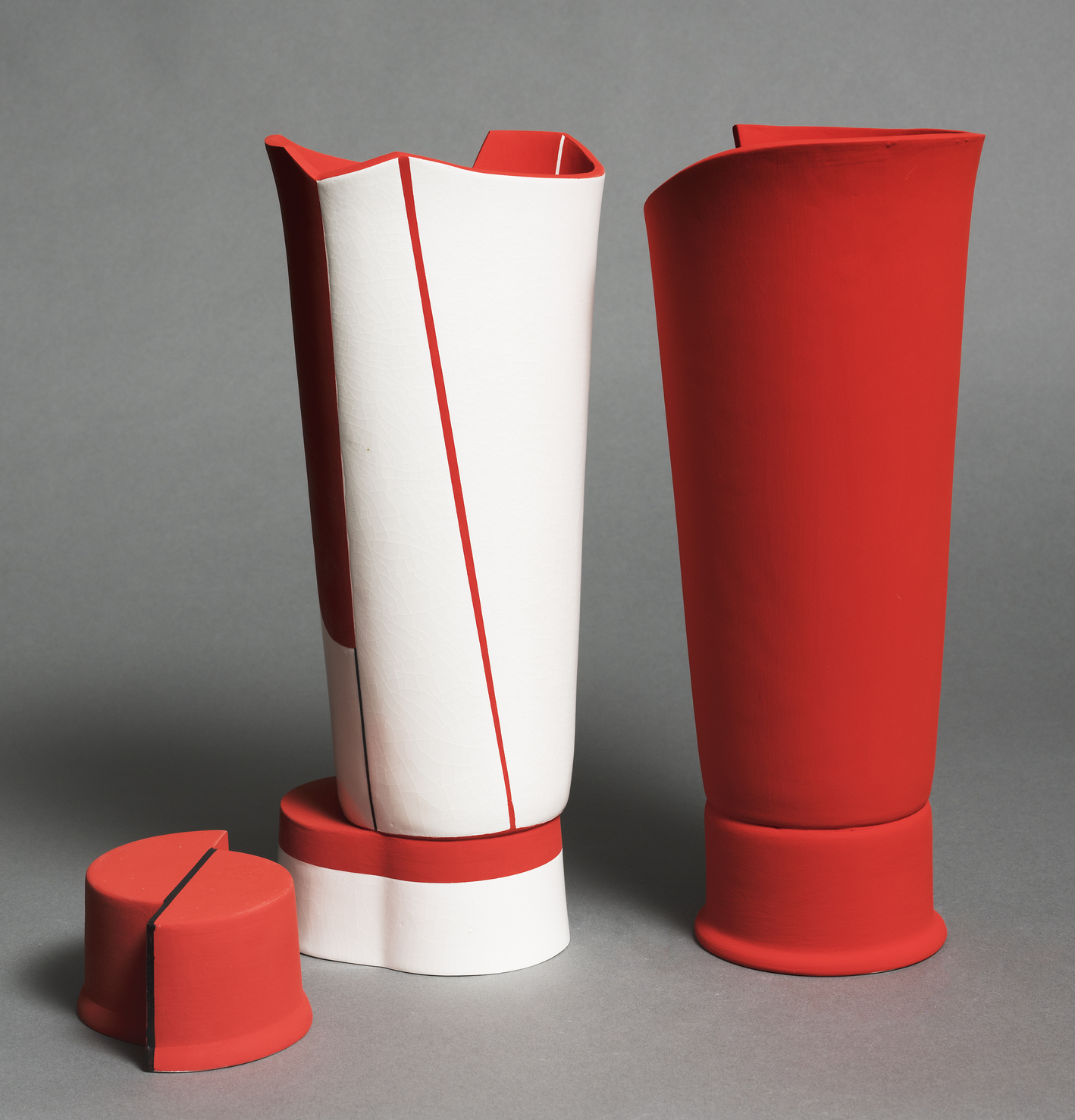
It is in the surface, however, that much of the work’s subtlety declares itself, because Cohen’s ceramics are not only about shape and silhouette, but equally about line, border, field, rhythm, and the movement of the eye across a form whose apparent calm is held in place by a great many decisions. Ann McMahon was right to note the graphic intelligence of the work, which is no doubt linked to Cohen’s printmaking background, because her surfaces do not behave like skins onto which decoration has been added. Rather, line and pattern do structural work, extending a contour, slowing the eye, tightening a proportion, or changing the emotional register of a piece with remarkable economy. A line may be too long. A lower section may feel too empty. A colour may have become too heavy for the object that carries it. Cohen often photographs works in progress in order to see them at a remove and decide whether they are actually holding together, whether balance has really been achieved or whether the work is still asking for something more. The movement from object to photograph and back again matters, because it shows that these ceramics are judged as much by optical intelligence as by touch.
This is where colour becomes especially important, and where the current body of work takes on a particular resonance. Cohen has spoken of wanting brightness, peace, and calm in the face of a world marked by war, doom, and gloom, and she has also written that “happiness itself can be a powerful act of protest.”³ Those statements matter because they refuse the easy assumption that joy is somehow politically naive or aesthetically unserious. In the present work, red, yellow, blue, black, and the white of the Cool Ice porcelain come together in a palette that cannot help but recall the classic Bauhaus language of chromatic clarity, yet the work does not feel merely historical or referential. Instead, it feels as though that modernist discipline has been warmed by biography, hospitality, and memory, so that the palette carries both formal precision and emotional charge. The red, yellow, blue, and black do not sit here as pedagogical primaries in a design exercise, but as concentrated signs of structure, rhythm, contrast, and delight, held against the white body of the porcelain in ways that make the surface feel at once exact and generous.
Such use of colour strengthens the connection to a broader history of beauty in contemporary art, though not in any soft or merely tasteful sense. Jacqueline Millner’s writing on conceptual beauty remains useful precisely because it insists that pleasure, reflection, and thought are not enemies, and Cohen’s work exemplifies that conjunction with unusual clarity, drawing the viewer close through elegance and chromatic brightness only to hold them there within a deeper field of migration, domestic ritual, architectural balance, and cultural layering.⁴ A further and more specific parallel appears in Blessed Be the Work: Australian Contemporary Design in Jewish Ceremony II, where the injunction of hiddur mitzvah is described as the act of imbuing the ritual object with beauty in order to enhance the ceremony itself, and where art is described as “a bridge between past and future.”⁵ That formulation is especially apt here, because it offers a way beyond the assumption that beauty weakens seriousness. In Cohen’s work, beauty is not an afterthought, nor a cosmetic finish laid over meaning. It is part of the object’s meaning from the outset, and part of how the work enters the world.
The domestic and ceremonial charge of that form remains one of the essay’s most important threads, because among all objects the vessel is one of the few that can still hold so much of ordinary life while opening so readily onto larger histories. McMahon’s identification of hospitality as a central motif in Cohen’s practice remains persuasive because it names the way these works move between the intimate and the cultural, the private and the social, the table and the world. The plate, platter, and vessel continue to carry the residue of serving, gathering, offering, and exchange, and in Cohen’s hands these actions become inseparable from migration, family history, architecture, and the symbolic life of domestic things. Her objects belong to the home, but never only to the home. They hold the table and the journey in the same form.
Glenn Adamson’s argument that craft should be understood not simply as medium-based practice but as a conceptual horizon within modern art is equally productive here, because Cohen’s ceramics do not become interesting by escaping craft, nor by remaining obedient to it, but by inhabiting the unstable, fertile space between vessel, sculpture, design, architecture, and decoration all at once.⁶ Howard Risatti’s insistence that function remains the vehicle through which thought is embodied in craft sharpens the point further, because the vessel in Cohen’s work is never an empty shell to which meaning is later attached. It is the generative form through which meaning becomes possible.
Failure, revision, and interruption also belong to this work, though they rarely announce themselves once a piece has settled into its final state. Cohen speaks matter-of-factly about cracks, glaze bubbles, wrong colour choices, overworked surfaces, and the loss of momentum that follows illness or absence, and one of the strengths of her account is that she refuses to dramatise such moments as if they were tragic exceptions to the true work of art. Some failed pieces go into the garden. Some remain as reminders. Some can be refired or stripped back. Some yield exactly the lesson that the next work needs. What matters is that revision remains internal to the practice rather than external to it, and that the finished works retain a sense of calm without ever becoming airless or overdetermined. They feel resolved but not closed, as though they have tested themselves.
To place Sarit Cohen more firmly within the broader history of contemporary Australian art is therefore not simply to recover an under-recognised practitioner from within a specialist ceramic field, but to recognise that some of the most subtle and compelling contemporary work still arrives through forms too easily dismissed as decorative, domestic, or minor. Laura Breen writes not only of the institutional circuits that have enclosed ceramics, but of “the mismatch between what was said about ceramics and what ceramics said,” and that phrase could hardly be more apt here.⁷ Cohen’s relative under-recognition certainly belongs in part to that history, yet her work makes equally clear why such a loop is no longer adequate. These vessels participate directly in contemporary conversations about migration, design history, hospitality, memory, pattern, material intelligence, and the politics of beauty, while remaining completely grounded in clay and in the labour of making. They ask for a viewer willing to stay with proportion, line, colour, and surface long enough for their deeper resonances to become audible, and willing also to recognise that beauty is not the opposite of seriousness but one of its most enduring vehicles. In these poised, cut, stacked, recomposed, and brightly resolved forms, architecture becomes intimate, memory takes contour, and many inheritances, once scattered across geographies, cultures, and generations, find a way to stand together in clay.
Cohen is holding a solo exhibition at Craft+Design Canberra from 30 July to 12 September 2026.
Written by Alexander Boyne - an Australian artist and curator based in Canberra/Kamberri.
Notes
1. John Berger, Ways of Seeing (London: British Broadcasting Corporation and Penguin Books, 1972), 7.
2. Michael Agostino, The Australian National University School of Art: A History of the First 65 Years (Canberra: ANU eView, 2010), 25–33, 81–90.
3. Sarit Cohen, “About the Artist,” accessed March 6, 2026, https://www.saritcohen.com.au/about-sarit-cohen; Sarit Cohen, interview by Alexander Boynes, in person, artist’s studio, March 31, 2026.
4. Jacqueline Millner, “Conceptual Beauty and Australian Contemporary Art,” in Conceptual Beauty: Perspectives on Australian Contemporary Art (Sydney: Artspace Visual Arts Centre, 2010), 186.
5. Helen Light, “Blessed Be The Work,” in Blessed Be the Work: Australian Contemporary Design in Jewish Ceremony II (Melbourne: Jewish Museum of Australia, Gandel Centre of Judaica, 1999), 7–8.
6. Glenn Adamson, Thinking Through Craft (Oxford: Berg, 2007), 4; Howard Risatti, A Theory of Craft: Function and Aesthetic Expression (Chapel Hill: University of North Carolina Press, 2007), 277–78.
7. Laura Breen, Ceramics and the Museum (London: Bloomsbury Visual Arts, 2019), 7.
8. Sarit Cohen, conversation with Alexander Boynes, April 3, 2026.
9. Sarit Cohen, note provided to Alexander Boynes, April 2026.
Bibliography
Agostino, Michael. The Australian National University School of Art: A History of the First 65 Years. Canberra: ANU eView, 2010.
Adamson, Glenn. Thinking Through Craft. Oxford: Berg, 2007.
Berger, John. Ways of Seeing. London: British Broadcasting Corporation and Penguin Books, 1972.
Breen, Laura. Ceramics and the Museum. London: Bloomsbury Visual Arts, 2019.
Cohen, Sarit. “About the Artist.” Accessed March 6, 2026. https://www.saritcohen.com.au/about-sarit-cohen.
Cohen, Sarit. Conversation with Alexander Boynes. April 3, 2026.
Cohen, Sarit. Interview by Alexander Boynes. In person, artist’s studio, March 31, 2026.
Cohen, Sarit. Note provided to Alexander Boynes. April 2026.
Light, Helen. “Blessed Be The Work.” In Blessed Be the Work: Australian Contemporary Design in Jewish Ceremony II, 6–8. Melbourne: Jewish Museum of Australia, Gandel Centre of Judaica, 1999.
McMahon, Ann. Sarit Cohen: recent works. 2009. PDF publication.
Millner, Jacqueline. “Conceptual Beauty and Australian Contemporary Art.” In Conceptual Beauty: Perspectives on Australian Contemporary Art. Sydney: Artspace Visual Arts Centre, 2010.
Risatti, Howard. A Theory of Craft: Function and Aesthetic Expression. Chapel Hill: University of North Carolina Press, 2007.

.png)

